- Wed 17 June 2026
- 11 min read
- Hardware
- #android, #fairphone, #apple, #fdroid, #kde-connect, #foss, #self-hosting, #repairability
For the better part of a decade I carried two phones. A personal iPhone 12 in one pocket and a work iPhone SE (2nd gen) in the other, the SE being a pure work device and nothing else. It worked, in the sense that two separate slabs of glass technically do the job. But it never felt right, and it never felt like mine.
The problem was not that the iPhones were bad phones. They were fine. The problem is that everything else I touch runs Linux or BSD, and an iPhone is a polite guest in that world at best. It does not really want to talk to a KDE desktop. It does not want you poking at its filesystem over USB. It assumes you live inside iCloud and treats every attempt to live outside it as a minor act of rebellion. I never used iCloud for anything serious, so I was permanently swimming against the current.
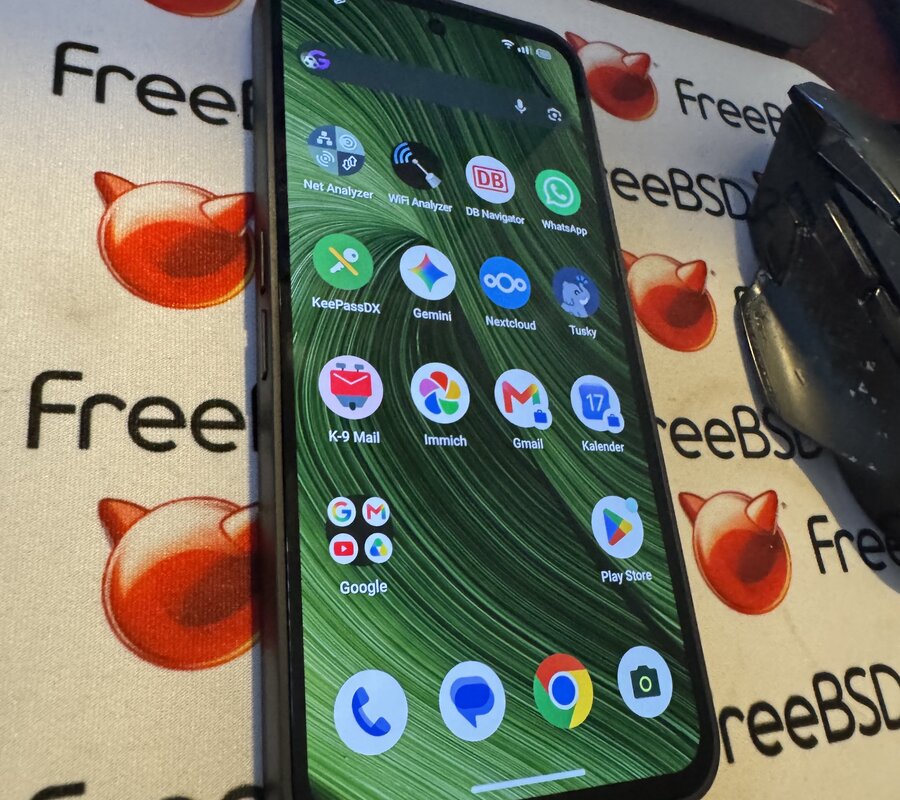
So I did the thing I had been circling for a long time: I collapsed two iPhones into a single Android phone, and I picked the most stubbornly un-Apple device I could justify. A Fairphone Gen6. This is the write-up of how that went, what I kept, what I swapped, and where the new setup actually hurts.
Table of Contents
Why a Fairphone and not “a nicer Android”
Let me get the obvious question out of the way first. If the goal was raw quality, I would have bought a Pixel or a flagship Samsung. I did not, and the reasons are not about benchmarks.
The Fairphone Gen6 sells on three promises that matter more to me than a faster chip:
- Five years of warranty. Not “up to”, not “with conditions you will never meet”. Five years.
- Eight years of software support and seven major Android versions. That is an absurd commitment by phone industry standards, where two or three years and then a slow death is the norm. A phone I can actually keep is worth more to me than a phone that is 20% faster and abandoned by 2028.
- Modularity that is real, not marketing. The battery, screen, back panel and USB-C port can all be swapped with a single screwdriver. Nothing is glued. Nothing requires a heat gun and a prayer. When the USB-C port wears out, and on a daily-carry phone it eventually will, I replace the part instead of the phone.
That last point is the one I keep coming back to. We have collectively accepted that a phone is a sealed, disposable object that you replace every couple of years because the battery degraded or one port died. The Fairphone simply refuses that premise. It is a device designed to be repaired by its owner, and after years of Apple hardware that treats the back of the device like a bank vault, that feels almost subversive.
It is not the fastest phone you can buy. We will get to that. But “fastest” was never on my list.
Android actually lives in my world
Here is the part that genuinely surprised me, even though it should not have. Android slots into a Linux and BSD centric workflow so much more naturally than iOS that the contrast is almost funny.
A few things that are simply true now, and were a fight before:
- I plug the phone into a USB port and the files are right there. No iTunes, no sync daemon, no asking permission. It is a device with storage and I can read and write it like one.
- KDE Connect ties it into my KDE desktop, and this is the feature I did not know I was missing. Shared clipboard, notifications mirrored to the desktop, send a file to the phone or grab one off it, use the phone as a remote, find the phone when it has fallen into the couch. All of it just works, over the local network, with no account and no cloud middleman. After years of iPhones pretending my Linux box did not exist, having the phone be a first-class citizen on my desktop is a small daily joy.
- F-Droid exists. Being able to install free and open source apps from a repository that is not a single corporate gatekeeper is a big deal to me, both on principle and in practice. A lot of my stack came straight from there.
None of this is exotic. It is the baseline you expect from a general purpose computer. iOS spent years training me to not expect it.
The app migration
This is the part people always assume will be painful, and for me it mostly was not. The reason is simple and worth being honest about up front: I was already self-hosting the things that matter, and I never lived in iCloud. If your photos, calendar and contacts are already on your own infrastructure, switching the client on the front end is a non-event. The data never moved.
Here is the actual before and after.
What stayed exactly the same
- Photos: Immich on my own server. The Android client is excellent, arguably better integrated than the iOS one. Auto-backup of the camera roll to my own box, no Apple Photos, no Google Photos. This did not change at all, I just installed the Android app and pointed it at the same server.
- Files, calendar and contacts: Nextcloud on my own server. Same story. CalDAV and CardDAV sync into the phone, files via the Nextcloud app. Nothing migrated because nothing needed to. The phone is just a new client.
- TOTP: FreeOTP. Cross-platform already, so this was a straight reinstall.
What I swapped
| Purpose | iOS | Android |
|---|---|---|
| Apple Mail | K-9 Mail | |
| Web browser | Safari | Vivaldi |
| Mastodon | Ice Cubes | Tusky |
| Passwords | Strongbox | KeePassDX |
The password story is the cleanest example of why this was easy. I was already using a KeePass database, with Strongbox as the iOS client reading it. Moving to KeePassDX on Android means a different app opening the exact same database file. The credentials never went near a vendor’s cloud, so there was nothing to export, migrate or trust. That is the whole argument for open formats in one sentence.
K-9 Mail, Vivaldi and Tusky were similarly painless. IMAP is IMAP, the web is the web, and Mastodon is an open protocol, so in every case I was just choosing a new front end onto data and services I already controlled.
A big plus I did not expect: GPG mail on the phone
This one deserves its own heading, because it is a genuine quality of life upgrade rather than a like-for-like swap. I can finally read and write GPG encrypted mail on my phone.
I do a fair amount of encrypted communication, and on iOS this was effectively a non-starter. Reading an OpenPGP encrypted message meant waiting until I was back at a real computer, every single time. On Android, K-9 Mail pairs with OpenKeychain to manage my keys, and encrypted mail just works: messages decrypt inline, signatures verify, and I can sign and encrypt outgoing mail from the phone like it is the most normal thing in the world. Because it is.
After years of treating my encrypted inbox as something that only existed at my desk, having it in my pocket is a bigger deal than the spec sheet of the phone ever could be.
The killer feature: work and personal profiles on one device
This is the thing that finally let me retire the second phone, and it is genuinely excellent.
Android’s work profile lets me run a completely separate, sandboxed profile for work apps alongside my personal one, on the same hardware. Work apps live in their own space, with their own storage, their own copies of apps, and their own clear visual marker so I never confuse the two. My employer’s mobile device management touches only the work profile and has no view into or control over my personal side.
The part I appreciate most: I can switch the work profile off. One toggle, and the work apps stop existing for the evening. No notifications, no badge counts, no email nagging at me from the work side until I turn it back on in the morning. After years of a dedicated work phone that I “solved” by physically putting it in a drawer, having that boundary be a software switch on my one device is exactly the separation I always wanted. Two iPhones gave me separation through brute force. One Android phone gives it to me through design.
Where it falls short: the camera
I am not going to pretend this device is perfect, and the weak spot is the camera.
In my testing it is mediocre. The bokeh on portrait shots is weird and artificial looking, colors come out flat, and the post-processing has an uncanny quality, the kind of over-smoothed, over-sharpened look where the software is clearly trying hard and missing. Against an iPhone 12 camera, it loses, no argument.
But here is the thing: I do not really care, and you might not either. For the actual job a phone camera does in my life, snapshotting a whiteboard, a parking spot, a thing in a shop, a quick photo to send to someone, it is completely fine. It captures the moment, the moment is legible, done.
And for anything that is actually photography, I have an EOS APS-C camera. I was never going to make real images on a phone regardless of the badge on the back. So a mediocre phone camera costs me nothing I valued. If phone photography is your primary camera, this is a real consideration and you should weigh it seriously. For me it is a rounding error.
The rest of the hardware tradeoff is similar. The CPU is not fast, and the phone is not a benchmark winner. But for my use, email, web, Mastodon, photos backing up in the background, the occasional map, it is more than enough. I have never once watched it struggle at something I actually asked it to do.
Was it worth it?
Getting out of the Apple ecosystem was much easier than I expected, and I want to be honest about why, because it is the real lesson here.
It was easy because I had already done the hard part years ago. My photos were on Immich. My files, calendar and contacts were on Nextcloud. My passwords were in a KeePass database. My second factors were in a portable TOTP app. I never bought into iCloud, so there was no gravity well to climb out of. The migration was not “leaving Apple”, it was “swapping the client apps on the front of services I already owned”. The lock-in that traps most people, the photo library and the contacts and the calendar all living in a vendor’s cloud, simply was not there for me to fight.
If there is a takeaway, it is that one. The best time to make leaving easy is long before you decide to leave. Own your data, use open formats, self-host the core services, and the choice of phone becomes what it always should have been: a choice about hardware, not a hostage situation.
I went from two iPhones that never felt at home in my world to a single, repairable, eight-year-supported Android phone that talks to my desktop like it was always meant to. The camera is meh. Everything else is a clear win. I am very satisfied, and I am carrying one phone instead of two.
Comments
You can use your Mastodon or other ActivityPub account to comment on this article by replying to the associated post.
Search for the copied link on your Mastodon instance to reply.
Loading comments...