
- Sun 02 August 2026
- 10 min read
- Cooking
- #cooking, #rice, #recipe, #off-topic
Table of Contents
I need to talk about rice.
This is admittedly unusual territory for a blog that spends most of its time on FreeBSD, routing, self-hosting, and the occasional recipe disguised as a shell script. But rice has been mistreated in Western European kitchens for long enough, and somebody has to open the incident report.
In Germany, rice is often treated as anonymous white ballast: boil a plastic Kochbeutel in a large pot of water, cut it open, put the pale contents next to the actual food, and deploy enough sauce to make nobody notice. Ugh. The result is technically edible in the same sense that a server answering ICMP is technically in production. It has passed the lowest possible health check.
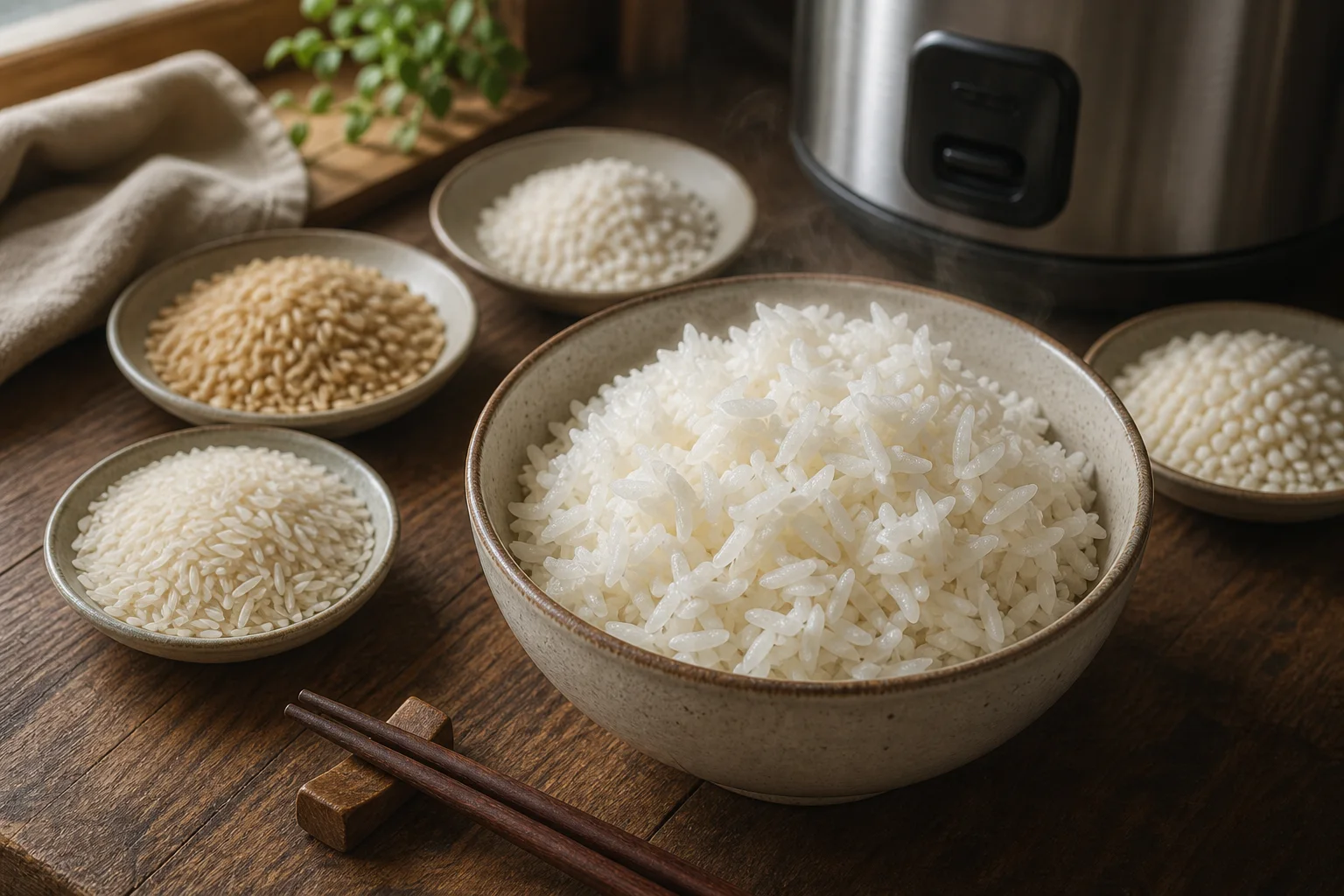
Rice can be floral, nutty, earthy, creamy, firm, fluffy, chewy, or satisfyingly sticky. It can carry a curry, become the curry, hold together under chopsticks, release enough starch to turn stock into risotto, or dissolve almost completely into congee. Which result you get depends on two decisions that are too often treated as afterthoughts: which rice you buy and how you cook it.
There is no single correct way to cook rice. There are, however, plenty of wrong combinations of rice, method, and desired result.
“Rice” Is Not a Useful Specification
The supermarket shelf is confusing because its labels describe several different properties as if they were alternatives in one flat list. Long-grain and short-grain describe shape. Brown and white describe how much of the grain has been milled away. Parboiled describes processing. Jasmine and basmati describe aromatic types. Arborio, Carnaroli, and Vialone Nano are individual varieties selected for particular cooking behaviour.
In other words, asking whether a rice is “brown or long-grain” is rather like asking whether a computer is “silver or running FreeBSD.” It can be both.
Grain length and starch
Rice is commonly grouped into long-, medium-, and short-grain classes. That is not just cosmetic. As a useful general rule, long grains cook up lighter and more separate, while shorter grains tend to be moister and cling together more readily. Much of that behaviour comes down to the balance of the starches amylose and amylopectin. The taxonomy has fuzzy edges, but it predicts texture far better than the generic word rice ever will.
- Long-grain rice is the territory of fluffy pilafs, many curries, and rice bowls. Jasmine and basmati both live here, but they are absolutely not interchangeable in flavour or texture.
- Medium- and short-grain rice generally becomes more cohesive. That is useful for sushi, rice pudding, paella, and other dishes where separate, dry grains are not the objective.
- Glutinous rice, also called sticky or sweet rice, is its own gloriously chewy thing. Despite the name, it contains no gluten. It is usually soaked and steamed, not treated like ordinary long-grain rice.
These are tendencies, not a complete database. Thousands of cultivars exist, and reducing all of them to three grain lengths is like classifying operating systems by the colour of their default desktop. Still, it is a better start than Kochbeutel versus loose.
Milling and processing
Brown rice is not a separate botanical family. It is rice with the bran and germ still present after the inedible hull has been removed. That gives it a nuttier flavour and a firmer, chewier texture, but also means it needs more water and considerably more time than the white version of a comparable grain.
White rice has been milled further to remove the bran and germ. It cooks faster, keeps longer, and covers an enormous range from fragrant Thai jasmine to Japanese short-grain rice. “White rice” tells you very little about how it will behave.
Parboiled rice is different again. The grain is soaked, steamed, and dried before milling. This changes the starch structure, moves some nutrients inward, and produces firm grains that stay separate and tolerate holding well. That makes it genuinely useful in canteens, prepared foods, and dishes where robust individual grains are wanted. It does not make it a substitute for aromatic jasmine rice, and it certainly does not make the plastic bag a cooking instrument.
A Small Field Guide to the Rice Shelf
This is not exhaustive, but it covers most of the labels likely to confront you in a European shop.
| Rice | What it is like | Where I would use it |
|---|---|---|
| Jasmine | Long-grain, fragrant, soft, and slightly clingy | Thai and Southeast Asian dishes, curries, fried rice, or simply eaten on its own |
| Basmati | Very long, aromatic grains that cook light and separate | Indian and Pakistani dishes, biryani, pilaf, chana masala |
| Generic long-grain | Usually mild and separate when cooked well | Everyday pilaf, rice salad, stuffed vegetables, dishes where the rice should stay in the background |
| Japanese short-grain / sushi rice | Plump, moist, and cohesive | Sushi, onigiri, donburi, Japanese meals where chopstick-friendly rice is expected |
| Arborio | Widely available risotto rice; becomes creamy readily but can turn soft quickly | Everyday risotto and rice pudding |
| Carnaroli | Risotto rice that holds its centre particularly well while building a creamy sauce | Risotto where texture matters and a little more tolerance around timing is welcome |
| Vialone Nano | Smaller risotto grain, highly absorbent and creamy | Looser, all’onda-style risotto; particularly associated with the Veneto |
| Brown rice | Bran intact, nutty, chewy, slower to cook | Grain bowls, salads, hearty side dishes, anywhere that texture is welcome |
| Parboiled rice | Firm, separate, resilient, less aromatic | Batch cooking, rice salads, canteen-scale service, or dishes that benefit from durable grains |
| Glutinous rice | Dense, chewy, and properly sticky | Lao and Thai sticky rice, mango sticky rice, dumplings; normally soaked and steamed |
The important part is not memorising the table. It is buying rice for the texture and flavour the meal needs. I would no more make risotto with basmati than I would serve a Thai curry over Arborio. Both are rice, but that is where the useful similarity ends.
The Method Is Part of the Dish
The Western default is often the pasta method: a large pot of boiling water, rice thrown in, water drained away at the end. It can produce acceptable rice, and in some cuisines excess-water cooking is entirely deliberate. It is also a poor default for good fragrant rice. Aroma and flavour leave with the cooking water, doneness is easy to miss, and the result is frequently wet, tired, and dependent on sauce for a personality transplant.
The absorption method starts with a measured amount of water and keeps it all in the pot. The rice absorbs the water, then finishes in its own steam. A saucepan with a tight lid can do this perfectly well, but a rice cooker makes the process wonderfully repeatable. It applies heat until the free water has been absorbed, switches to warming, and lets the rice finish without demanding burner management from the operator.
That does not mean every rice belongs in a rice cooker:
- Risotto depends on gradually adding stock, stirring, and deliberately drawing starch from the grain into the surrounding liquid.
- Paella needs its wide pan, controlled evaporation, and ideally the toasted layer at the bottom.
- Congee uses a large amount of water on purpose and cooks until the grains break down.
- Glutinous rice is traditionally soaked and steamed.
- A good pilaf begins by coating or toasting the grains in fat before adding measured liquid.
Different methods are not competing answers to one question. They are building different dishes.
My Rice-Cooker Baseline
My favourite everyday rice is Golden Phoenix Thai Hom Mali jasmine rice. I buy it in 18 kg bags from the Asian supermarket, which is both more economical and a useful declaration that rice is not an occasional side dish in this household.
Thai Hom Mali is a fragrant jasmine rice, and this particular one gives me exactly what I want: distinct, fluffy grains with enough cohesion to pick up comfortably with chopsticks. It also tastes of something. That last point should not feel revolutionary, but anyone raised on anonymous boil-in-bag rice will understand why it does.
Here is the method I have arrived at after a great deal of repetition. Use the same cup for both rice and water; its absolute size does not matter.
- Put 1 cup of rice into the rice-cooker bowl.
- Add 2 cups of cold water and leave it for about 15 minutes. Gently move the rice around with your fingers. This is my combined short soak and wash.
- Carefully drain that water away. There is no need to polish every grain under seven ceremonial changes of water; a light wash is enough for the texture I want.
- Add 1.5 cups of fresh water.
- Start the rice cooker and leave it alone. No stirring, no lid lifting, no production debugging.
- When the cooker switches to warm, wait at least 15 more minutes before opening it. This rest is part of the cooking process, not an inconvenient delay between cooking and eating.
- Open, gently fluff the rice, and serve.
The ratio is a baseline, not a universal constant. Rice variety, age, cooker geometry, and personal preference all move it. If the rice is too soft, reduce the fresh water slightly next time. If the centre is too firm, add a little more. Change one variable, observe the result, and keep the setting that works. Apparently even dinner benefits from controlled experiments.
The final 15-minute rest is the step I would defend most strongly. Straight after the switch clicks, moisture is still unevenly distributed and the surface grains are wetter than the centre. The warm rest lets that settle. Open too early and you throw away the easiest texture improvement available to you.
Washing Is a Dial, Not a Religion
Few rice topics generate as much rigid advice as washing. “Always rinse until the water is perfectly clear.” “Never wash because you lose starch.” Both are incomplete.
Washing removes loose surface starch and whatever fine material accumulated during milling and transport. For jasmine rice, a light wash helps prevent a gummy exterior while preserving the slight cling I actually want. For a very separate basmati pilaf, I would rinse more thoroughly. For risotto, I would not rinse at all because the available surface starch is part of the mechanism that makes the dish creamy.
The desired result decides the procedure. Not a commandment copied from a recipe that used a different grain on a different continent.
Buy Better Rice, Then Get Out of Its Way
A rice cooker does not need Wi-Fi, an app, fuzzy-logic branding, or seventeen menu modes. A basic mechanical cooker with cook and warm is already one of the highest-return appliances in a kitchen. Give it decent rice, a measured amount of water, and enough time to rest, and it will outperform generations of hurried saucepan improvisation.
More importantly, taste the rice before you bury it. Try jasmine next to basmati with nothing but a little salt. Compare brown rice with its white equivalent. Make the same risotto once with Arborio and once with Carnaroli. Notice what changes. Rice becomes much more interesting the moment you stop treating it as a blank carbohydrate transport layer.
And if somebody reaches for a Kochbeutel, intervene gently. They may simply never have been served rice that was allowed to have a character of its own.
Sources and Further Reading
- The International Rice Research Institute on grain classes, starch, and aromatic rice
- The FAO on milling, parboiling, washing, and cooking
- The EU’s geographical-indication profile for Riso Nano Vialone Veronese PGI
- The producer’s overview of Golden Phoenix Thai Hom Mali rice
Comments
You can use your Mastodon or other ActivityPub account to comment on this article by replying to the associated post.
Search for the copied link on your Mastodon instance to reply.
Loading comments...