
- Sun 07 June 2026
- 9 min read
- DIY
- #diy, #air conditioning, #home, #summer, #off-topic
I moved this February. New city, new apartment, top floor of a building that went up sometime in the 1970s, in the Rheinebene, which for the non-Germans reading this is one of the warmest and most reliably sticky regions in the country. The flat is rented, which matters more than it sounds like it should, and I work from home with a dedicated office. Come the first proper heat of June, that office is the problem child of the whole apartment: small, under the roof, and facing the sun.
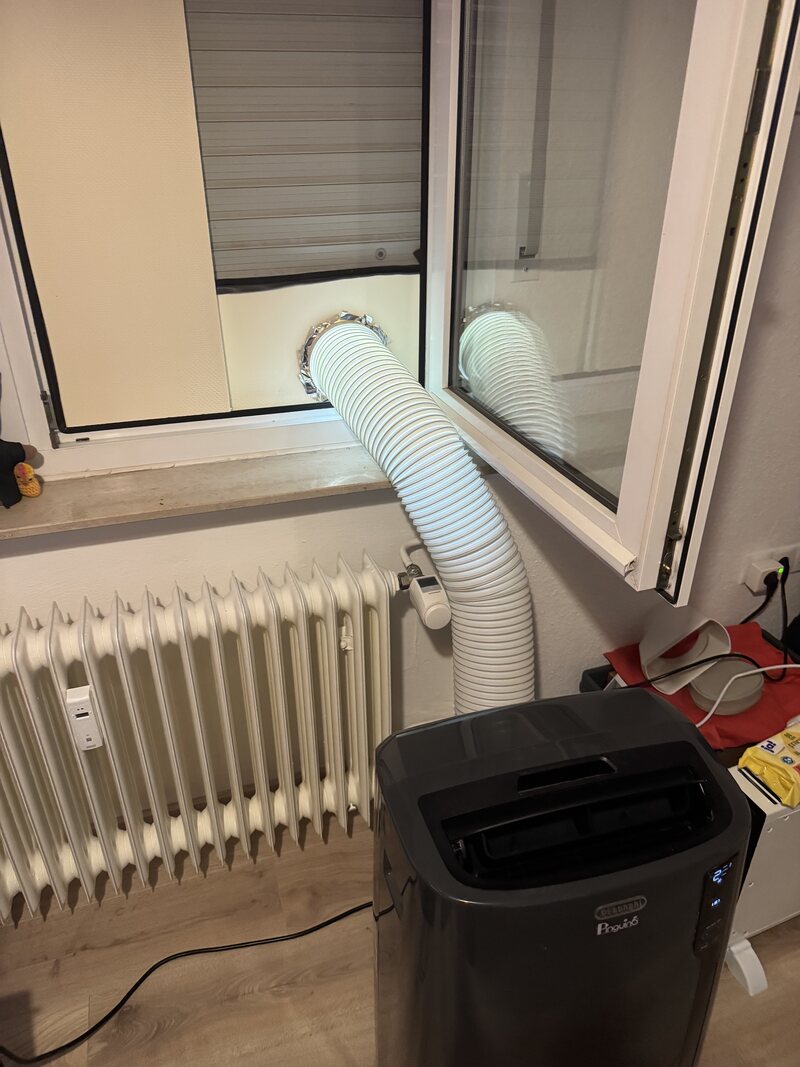
Air conditioning is still uncommon in German homes. Only a minority of households have any at all, and a fixed split system, the efficient kind with the compressor bolted to an outside wall, is essentially off the table when you rent: it needs a hole through the facade and a landlord who says yes. So like a lot of people in this situation, I ended up with the compromise nobody is proud of: a single-hose portable unit. A “monoblock”. Mine is a DeLonghi PAC EL 112 CST, the “Pinguino”, an 11,000 BTU/h machine I bought several years and one apartment ago.
This post is three things stacked on top of each other. First the personal bit, which you just read. Then a short, honest detour into why these portable units are bad at their one job, because it explains everything that follows. And finally the actual point: the cheap, ugly, removable thing I built to seal the window, which turned out to matter far more than the air conditioner itself.
Why a single-hose portable AC is fighting itself
Here is the physics, briefly, because it is the whole reason the seal matters.
Any air conditioner is a heat pump. It does not destroy heat, it moves it: it pulls heat out of the room air and dumps that heat somewhere else. In a split system, “somewhere else” is a separate unit outside, and the inside and outside halves are connected only by thin refrigerant lines. The room stays a closed box. That is why split systems are efficient.
A single-hose monoblock has to do all of that in one box sitting in the room, and it gets rid of the heat by blowing hot air out through a single fat hose to the window. That one hose is the original sin. To push that hot air outside, the unit is constantly sucking air out of the room. Air that leaves has to be replaced, so the room goes very slightly negative-pressure and pulls replacement air in from everywhere else: under the door, around the window frame, through every gap in a 50-year-old building. And that replacement air is warm, unconditioned outside-and-hallway air. So the machine is, in effect, partly air-conditioning the rest of the building and the great outdoors, one infiltrated breeze at a time. A dual-hose unit fixes some of this by drawing its own outside air for cooling the condenser, but mine, like most of the cheap ones, has a single hose.
There is a second, dumber loss layered on top, and it is the one you can actually do something about. The hose is hot. The window opening it runs through is a hole in your thermal envelope. If that opening is not sealed, the hot air you just paid to expel, plus the sun-baked air sitting right outside, comes straight back in around the hose. You can have a perfectly good compressor and still lose the fight at the last 20 centimeters, at the window.
That last 20 centimeters is the part I can control in a rented flat. So that is where I put the effort.
What the shops sell you, and why it is bad
The commercial answer to “seal the window around the hose” is a fabric kit: a sheet of cloth with a zip, a hole for the hose, and a strip of adhesive hook-and-loop you glue around the inside of your window frame. I have used these in two previous apartments. They are bad.
The fabric is thin, so in direct sun it heats up like a parked car and then radiates that heat happily back into the room, undoing a chunk of the work the AC is doing. It sags. It never fits the specific window you actually own, only some platonic window from the product photo. The adhesive strip peels off in the heat, which is exactly when you need it. And aesthetically it looks like you have sealed your room for fumigation. The seal it provides is mediocre and the insulation it provides is essentially zero, which is the wrong way around: a window port wants to be insulating first and merely airtight second.
I do not have good crafting skills. I want to be honest about that, because what follows is not a display of craftsmanship. It is what happens when someone with no crafting skills gets annoyed enough to go to the hardware store anyway.
The build: XPS, tape, and a sharp knife
The material that fixes all of the fabric kit’s problems at once is XPS, extruded polystyrene, sold here under names like Styrodur. It is the rigid, usually pastel-colored closed-cell foam board used for building insulation. It is cheap, it is light, it cuts with a kitchen knife, and crucially it is a genuine thermal insulator rather than a thin sheet that just blocks the gap. Rigid also means it holds a shape and an edge, so it actually fits the window instead of draping over it.
My shopping list was almost embarrassingly short:
- one panel of XPS / Styrodur
- a roll of insulation tape
- self-adhesive rubber sealing strip (the kind sold for draught-proofing doors)
- a sharp knife I already owned
The window in the office is the common German tilt-and-turn type with an external roller blind. That blind turned out to be the entire trick. Instead of trying to seal the whole openable window, I cut the XPS into a strip sized to span the opening and clamp in place between the bottom of the roller blind and the windowsill. I lower the blind onto the top edge of the panel and the panel is simply held there, under gentle pressure, no glue, no screws, nothing permanent.
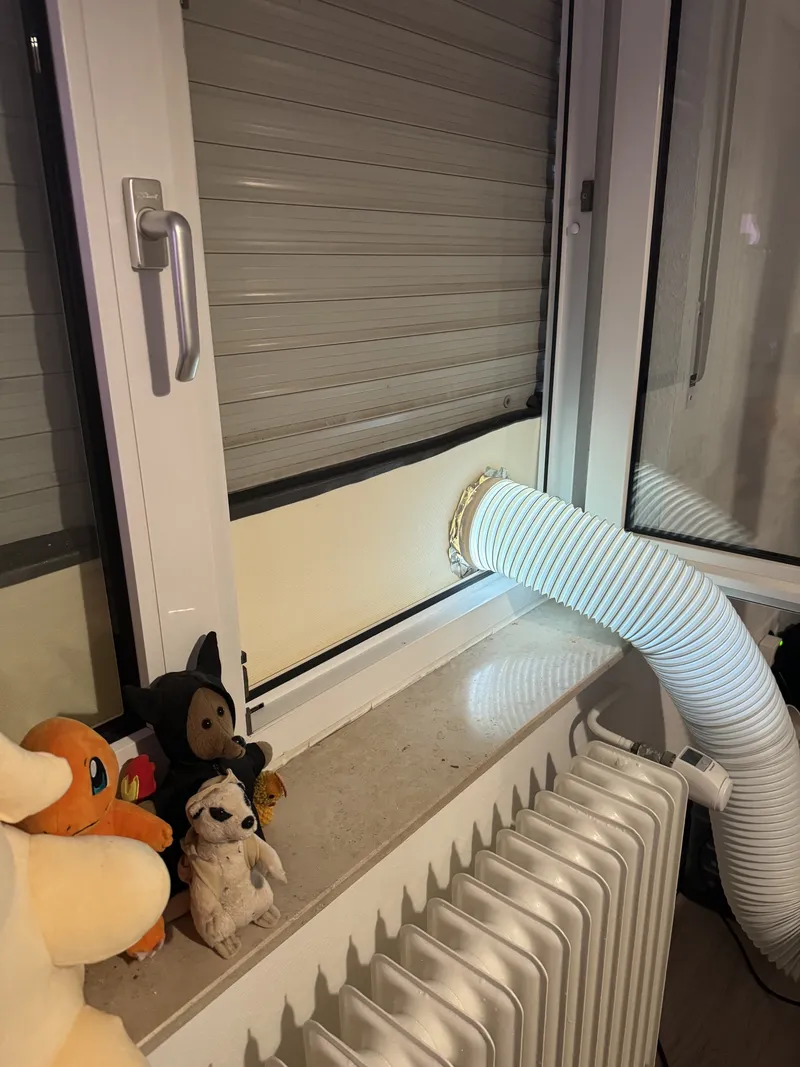
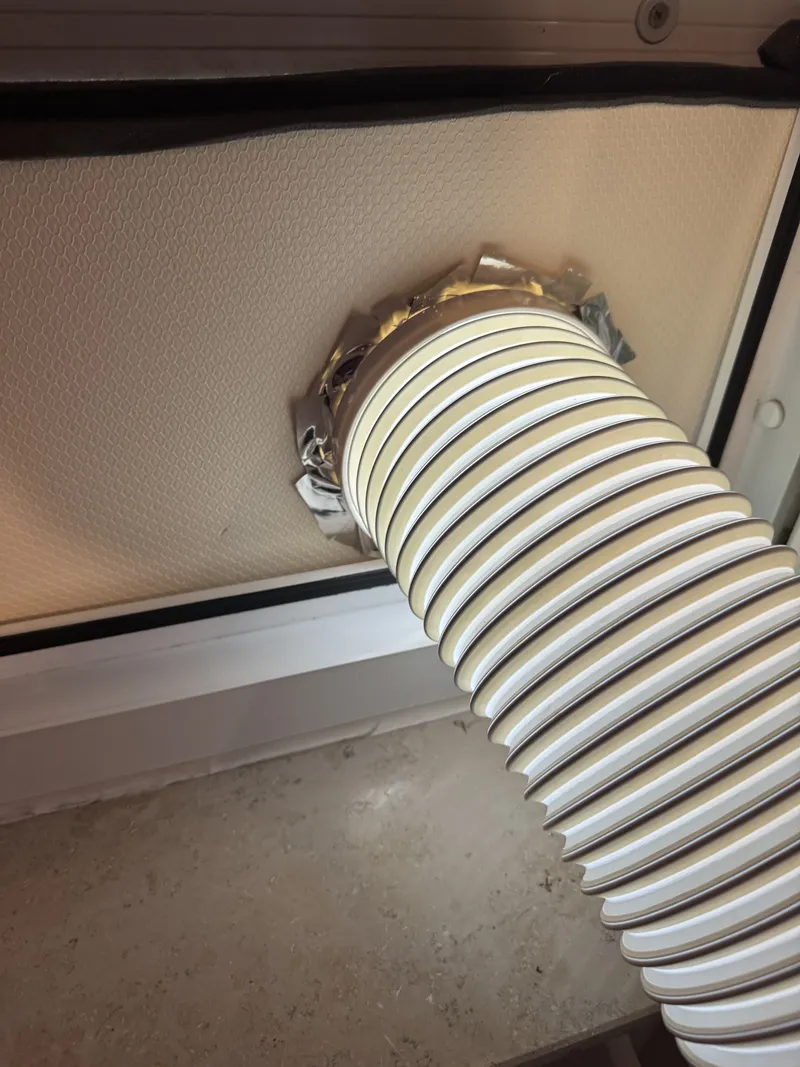
Then I cut a round hole in the panel to fit the AC hose’s window adapter, working up to size slowly with the knife because you cannot un-cut foam. The hole is the one place a rigid panel can still leak, so that is where the rest of the materials go. I sealed the gap between the hose adapter and the foam with the rubber strip and the insulation tape, packing it until the join was snug and there was no obvious daylight path for air. It is not aerospace-grade. It does not need to be. It needs to stop a warm draught, and it does.
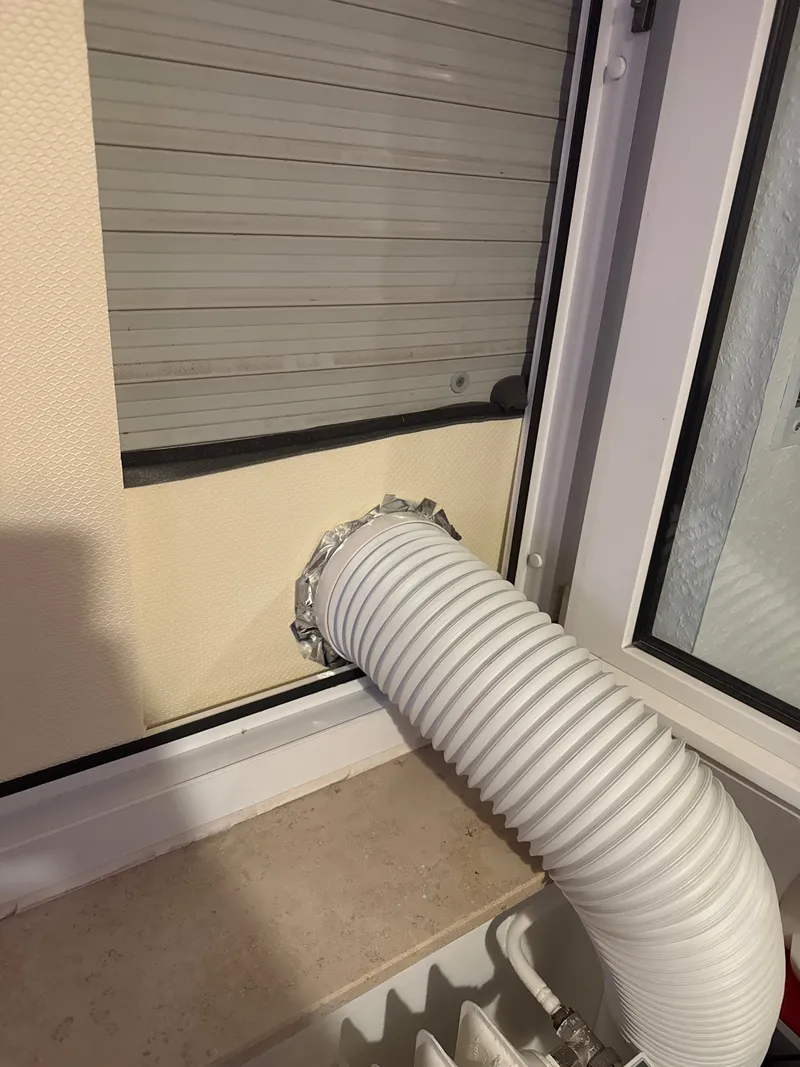
The detail I care about most is the seal around the rim of the panel itself. The self-adhesive rubber runs along the edges so the foam meets the frame and sill with a soft, compressible line rather than a hard plastic-on-plastic gap. That is the difference between “there is a board in the window” and “the opening is actually closed”.
Does it actually work? Yes, surprisingly well
The first genuinely hot days of 2026 arrived right on cue, daytime temperatures above 30 °C, and this was the test.
It works far better than I expected. With the panel in and the hose sealed, the Pinguino pulled the office down by 6 to 7 °C in about 45 minutes, at which point it had reached the setpoint and switched itself off rather than grinding away pointlessly. That is the behavior you want and almost never get from a portable unit in an un-sealed room, where the thing runs continuously and never quite wins.
Two things combine to produce that result, and they are worth separating.
The first is the seal, which is the whole subject of this post: closing the window opening with something that insulates as well as blocks airflow removes the dumb last-20-centimeters loss and stops the just-expelled heat from circling straight back in.
The second is, honestly, brute force. The office is tiny, roughly 3 by 4 meters, and an 11,000 BTU/h unit is comically oversized for 12 square meters. In a normal installation you would not want that: an oversized AC short-cycles and dehumidifies poorly. But a single-hose monoblock is so systemically lossy that the oversizing stops being a flaw and becomes the counterweight. The raw cooling capacity simply overwhelms the infiltration and the inefficiency. A right-sized unit in a leaky-by-design configuration would lose the race. A deliberately oversized one in a properly sealed small room wins it comfortably. Two wrongs, in this one specific case, make a tolerable right.
The honest downside
There is a price, and it is light. The roller blind has to be down to clamp the panel, and the panel itself is opaque foam, so the window is effectively blacked out while the system is in use. The office goes from “bright room with a view” to “cool cave”. On a 33 °C afternoon in a top-floor home office where I am trying to actually think, that is a trade I will take every single time. Light I can replace with a lamp. The heat I could not replace with anything except misery.
What I would tell past me
If you are renting, you cannot have the efficient air conditioner, and that is just the situation. But most of what makes the cheap portable one feel useless is not the compressor, it is the window. Before you blame the unit, seal the opening properly, and seal it with something that insulates, not a sheet of hot fabric. A few euros of rigid foam board, a roll of tape, and some draught-proofing rubber did more for my comfort than anything about the machine itself.
It is not pretty, it blocks the light, and a craftsman would wince at it. It also dropped my office 7 degrees on the hottest day of the year so far, comes out in ten seconds when summer ends, and left no mark on a flat that is not mine. For a top-floor office in the Rheinebene, that is the whole job.
Comments
You can use your Mastodon or other ActivityPub account to comment on this article by replying to the associated post.
Search for the copied link on your Mastodon instance to reply.
Loading comments...